Heavy aggregate staging requires strict containment geometry because cured slab fragments, pavers, and trench dirt exceed the bulk mass of typical construction refuse. Standard construction boxes can quickly overload…
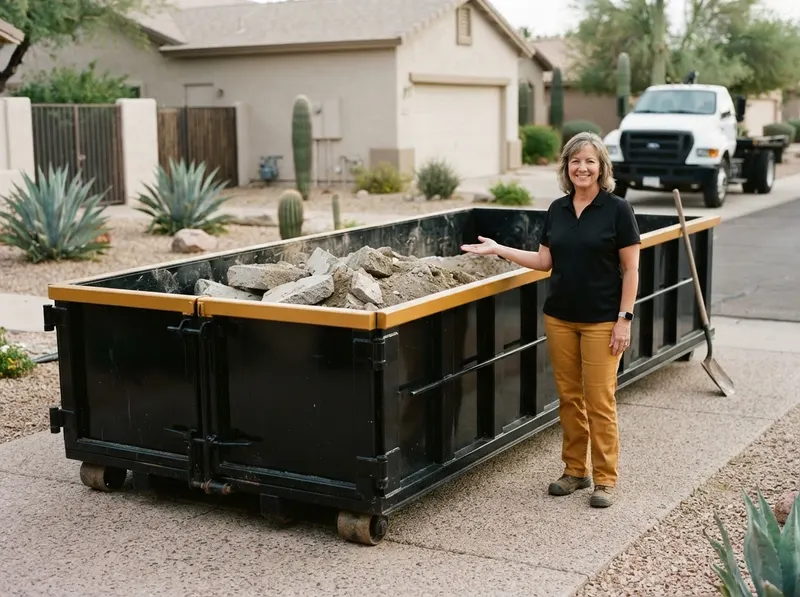
Heavy aggregate staging requires strict containment geometry because cured slab fragments, pavers, and trench dirt exceed the bulk mass of typical construction refuse. Standard construction boxes can quickly overload standard axle tolerances, which is why municipal regulations overseen by the City of Phoenix Public Works Department require exact compliance for highway transit. Oakline Container Group delivers dedicated heavy-duty aggregate units engineered to maintain stable gross vehicle weights. A single cubic yard of compacted caliche soil or broken patio concrete weighs roughly 2,000 to 3,000 pounds, meaning standard driveways can suffer stress fracturing if placement plates are neglected. Our drivers execute direct wooden cribbing deployment to protect residential surfaces, avoiding common HOA penalties enforced by residential management boards across Arcadia, North Central Phoenix, and the Biltmore Area.
Project managers must plan aggregate segregation prior to equipment arrival. Inert recycling facilities regulated by the Arizona Department of Environmental Quality impose strict rejections if organic trash, lumber, or chemicals mix with clean masonry loads. When sorting materials for concrete recycling under the standards established by the American Concrete Institute, rebar must be cut flush with the slab edge. Clean masonry aggregate gets diverted from standard regional municipal dumps to regional crushing plants for reuse in roadbase infrastructure managed in accordance with guidelines from the Arizona Department of Transportation. If soil excavated from sites near Camelback Mountain or Paradise Valley Village contains trash or roots, it cannot travel as clean fill and must be rerouted to general municipal waste facilities.
Transporting dense debris across major Phoenix transportation corridors requires continuous alignment with safety benchmarks set by the Federal Motor Carrier Safety Administration and roadside enforcement coordinated by the Arizona Department of Public Safety. When commercial demolition crews near Desert Ridge, Maryvale, or the State Farm Stadium corridor stage aggregate roll-offs, units must be loaded uniformly. Materials should never exceed the steel top rail, adhering to jobsite containment measures defined by OSHA Regulations. For cleanout teams working around Ahwatukee Foothills or South Mountain Village, staging the box on flat, hard-packed ground prevents hydraulic stabilization legs from sinking into unpaved Arizona caliche.
Selecting the correct container volume depends on material density and loading equipment. A 10-yard container works for small hardscape tear-outs, sidewalk cuts, and trench backfill dirt, while commercial parking lot demolition demands larger 20-yard or 30-yard footprints to match skid-steer bucket widths. Hauling concrete from historical neighborhoods such as Encanto Village requires permits if containers sit within public rights-of-way, following regional oversight from the Maricopa County Government. Staging within private property lines avoids these municipal delays. Sourcing high-capacity steel containment directly prevents structural job halts, keeps jobsites compliant with stormwater runoff protocols tracked by the US Environmental Protection Agency, and keeps residential corridors free from loose rubble.
Every job gets a firm, written price after a free on-site visit.
For standards, safe disposal, and service guidance on DUMPSTER in Phoenix, AZ, useful references include U.S. EPA, EPA, EPA, OSHA, Earth911, and Google Maps. General consumer and small-business resources are available from USA.gov, Better Business Bureau, FTC Consumer Advice, U.S. Small Business Administration, and Ready.gov.
Tell us about your concrete and dirt disposal dumpster job in Phoenix and we'll send a clear, written quote, usually the same day.
 Oakline Container Group